
PINETOP-LAKESIDE, Ariz. — The Pinetop-Lakeside Planning & Zoning Commission voted Dec. 11 to recommend code changes tied to a new state law shifting many development approvals from public hearings to staff review. Prompting feedback from Legislative District 7 Rep. Walt Blackman.
During the meeting, Pinetop-Lakeside Community Development Director Jeremiah Lloyd told commissioners that the town is effectively required to revise its process to comply with state statutes tied to House Bill 2447 — legislation signed into law in 2025 that takes effect “from and after December 31, 2025.” Arizona Legislature
Lloyd said the law’s language changed in a way that removed local discretion. “The first time I saw the reading of this, he said, it said we may do these things and then… recently saw that they changed, struck the May, and they changed that to Shall. So we pretty much have to do this in order to comply with state statute.”
The agenda item as discussed at the meeting referred to “House Bill 2247,” but the state law addressing municipal administrative approvals is HB 2447, chaptered as Laws 2025, Chapter 31, amending A.R.S. § 9-500.49. Arizona Legislature
The town amended the Pinetop-Lakeside Town Code, Sections 16 and 17, Subdivision and Site Plan Review, at the Dec. 11 meeting to comply with House Bill 2247.
New chair elected, then the HB 2447 discussion begins
Earlier in the meeting, commissioners selected new leadership after the prior chair and vice chair resigned. Lloyd said former Chairman Jack Pence and Vice Chairman Timothy Kenlake had resigned, leaving the commission “kind of in a bind.”
Rick Miller was appointed chair on a 4–1 vote and then emphasized the importance of community engagement. “It’s really important that we have engagement from our community members in the planning and zoning process. We’re all volunteers up here.”
After Rick Miller was selected as chair, the commission appointed Commissioner Wesley as vice chair of the Planning & Zoning Commission.
What HB 2447 changes
HB 2447 requires cities and towns to adopt ordinances that authorize staff to approve certain development applications without public hearings, including items that often draw neighborhood attention, such as subdivision plats and site plans. The chaptered law states municipalities must: “Authorize administrative personnel to review and approve site plans, development plans, land divisions, lot line adjustments, lot ties, preliminary plats, final plats, and plat amendments without a public hearing.”
It also requires all Arizona cities and towns to: “Authorize administrative personnel to review and approve design review plans based on objective standards without a public hearing.”
The legislation defines “objective” as: “not influenced by personal interpretation, taste or feelings of a municipal employee and verifiable by reference to an adopted benchmark, standard or criterion available and knowable by the applicant or proponent.”
Lloyd told commissioners the practical effect is that the town would no longer hold public hearings for subdivisions or certain site-plan approvals—though rezoning and other discretionary land-use actions would still require hearings. “No public hearings would be held for… anybody that came to the town with a subdivision… or even… a change to a commercial structure for a site plan.”
Warning of consequences for noncompliance
When asked what would happen if the town declined to adopt the changes and continued public hearings, Lloyd cautioned that the town could face serious consequences, “If we choose not to comply with state statute, we could have a series of problems, including… losing our state shared revenues.”
HB 2447 itself does not list that penalty in its text, but Lloyd described it as part of the compliance risk for municipalities operating under state-granted zoning authority.
Commission discussion also noted the timing pressure: the law takes effect after Dec. 31, 2025. Town staff acknowledged the town likely would not have final code changes in place by the deadline, but Lloyd said there were no major projects “waiting in the wings” and any new applications arriving after the effective date would be handled under state statute regardless.
Public speaker: “A huge loss” of local influence and oversight
Longtime resident Robert Engels, who said he has lived in Pinetop-Lakeside since 1978, urged caution and expressed concern about reduced oversight and the town’s ability to enforce standards. “A huge loss of the ability of the planning commission to influence the quality of development we get… in the future.”
Engels pointed to what he described as a recent example involving landscaping and tree removal at the Circle K in Pinetop, arguing the issue never returned to the commission even though he believed the original plan required “a natural forested landscaping.”
Engels asked the commission not to approve the proposed changes immediately and suggested further work and input before sending recommendations to the council. “I would like to see the planning commission not go ahead and approve it yet… perhaps a early January meeting… to work on a best recommendation to go to council,” said Engels.
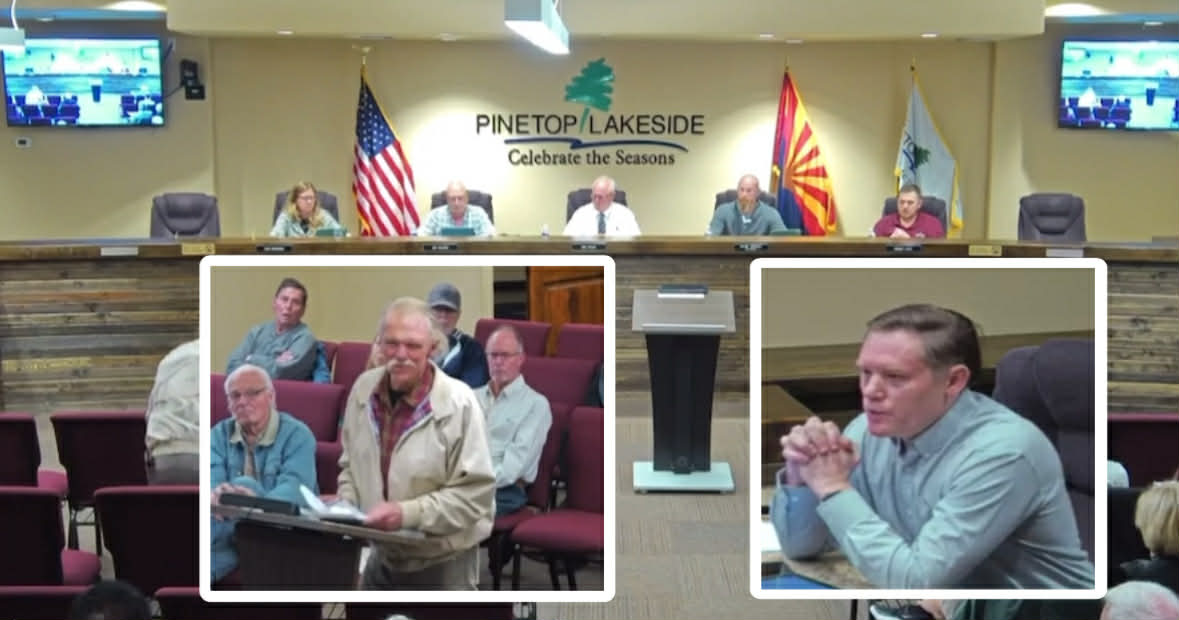
Robert Engles speaks at the Dec.11 Pinetop Lakeside Planning and Zoning meeting.
Commission seeks workaround: neighborhood meetings, not hearings
While commissioners acknowledged they could not restore public hearings for the covered approvals under HB 2447, they discussed options to preserve some level of neighborhood input.
Chairman Miller and others discussed changing the ordinance language from “strongly encouraged” to a requirement that developers hold a neighborhood meeting for nearby property owners. Lloyd said that approach could still fit within the new statutory framework because it would not be a formal “public hearing.” “We just can’t have a public hearing,” said Miller, so we could still meet with the public and take their concerns into the part of the equation. But the opportunity for public involvement via public hearing would be eliminated.”
One local asked if the town could tighten its own codes to regain “a little bit more control back to the townspeople,” prompting discussion about future code revisions and the importance of clear standards.
Another resident summarized what they understood the law to mean: “Essentially, the town sets the codes and then you will hold the developer to those standards… It’s black and white.”
Commissioners and staff agreed that code amendments still go through planning commission and council processes, meaning the public could still participate in broader zoning and code policy, even if not on certain project approvals.
Motion on subdivisions: recommend changes with neighborhood notice requirement
On the Title 16 subdivision item, the commission voted to recommend code amendments to comply with HB 2447, while adding conditions to preserve notice and neighborhood engagement.
A commissioner moved to recommend Title 16 changes “to comply with HB 2447” and allow administrative reviews without public hearings, while requiring the applicant to provide notice of a neighborhood meeting to addresses within 300 feet. “Stipulating that the applicant must provide notice of a community meeting… within 300 feet… I might call it a neighborhood meeting rather than a community meeting,” said Miller.
The motion included discussion of placing the burden on the developer—not town staff—to mail notices and to attest that they did so, with the possibility of requiring a minimum notice period (such as two weeks). The subdivision item ultimately passed with one opposition.
The Planning & Zoning Commission voted 4–1 to recommend amendments to Title 16 (Subdivisions), advancing changes required to comply with House Bill 2447. The motion would allow administrative approval of subdivisions without a public hearing, while adding a local safeguard requiring developers to hold a neighborhood meeting and provide notice to property owners within 300 feet of a proposed project. One commissioner opposed the recommendation, citing concerns that the changes do not serve the community’s best interests.
Motion on site plans: passes 3–2 amid discomfort
On the Title 17 site plan review changes, Lloyd said the proposal was “pretty much the same deja vu” but “a little more painful” because it removed one of the commission’s limited remaining powers.
Engels again raised concerns about reduced public notice and the loss of public visibility in site plan approvals, adding that the historic-site exceptions discussed in the statute were unlikely to matter locally because the town has not established a historic preservation commission.
The commission then voted 3–2 to recommend Title 17 amendments to the council to comply with HB 2447 and allow administrative review without public hearings.
After the vote, a commissioner told the audience the change was being forced by the state and encouraged residents to contact legislators if they wanted the law changed.
What happens next
Because HB 2447 becomes effective after Dec. 31, 2025, municipalities are racing to adopt compliance ordinances and rewrite local codes. The Town of Pinetop-Lakeside’s recommendations now move to the Town Council for consideration.
HB 2447’s required shift—administrative approvals without hearings for many site plans and subdivision-related actions—has already prompted public reminders and guidance from other Arizona municipalities and the Arizona League of Cities and Towns as communities work to implement “objective standards” and new administrative workflows.
Mountain Daily Star reached out to State Rep. Walt Blackman, chairman of the House Government Committee and representative for Legislative District 7. He framed the law as a direct hit to public participation—particularly for rural communities that often feel the impacts of development decisions most acutely.
“This bill cuts the public out of decisions that shape their own communities. It hands real power to unelected staff, hides decisions from public view, and calls it efficiency. As a Representative for Legislative District 7—where rural and tribal communities live with the consequences of these decisions—I will not stand by while hard-working Arizonans and rural residents are sidelined in their own hometowns,” said Rep. Blackman.
Kristi Salskov said at the Dec. 18 Town of Pinetop-Lakside meeting that the action will come before the Town Council at the beginning of February.
And for those who see the state law as a fundamental shift in local control, the commission’s message was blunt: the change is arriving, and the fight—if there is one—moves to the Legislature.
Call your Arizona State Reps to comment on this Legislation. You can reach LD7 Rep.Blackman at WBlackman@azleg.gov