APACHE COUNTY — In the summer of 1936, high on the shoulder of Escudilla Mountain near Alpine and Nutrioso, a government trapper killed the last grizzly bear in Arizona, ‘Old Bigfoot.’ Nearly ninety years later, new voices are calling to bring the grizzly back to Arizona.
Though largely forgotten in northern Arizona today, grizzlies once roamed freely through Oak Creek Canyon and the San Francisco Peaks. Less than a century ago, they ranged from the Chiricahua Mountains near the Mexican border to the White Mountains of eastern Arizona.
The grizzly’s name comes from the white-tipped, grayish, or “grizzly” fur in the bear’s coat. However, the naturalist George Ord mistook this word for “grisly,” influenced by Lewis and Clark’s description of their terrifying personal encounter with a bear, and named the subspecies horribilis.
The last known Arizona grizzly bear, an old solitary boar (male) called Old Bigfoot, was remembered by ranchers across Apache County for his massive tracks and his habit of raiding livestock.
Ecologist and wildlife biologist David E. Brown, author of The Grizzly in the Southwest: A Documentary of an Extinction, established that the final encounter occurred on Escudilla Mountain in 1936. Before his passing in 2021, Brown confirmed that the man who killed Old Bigfoot was a federal predator-control agent with the U.S. Biological Survey—the agency charged with removing animals seen as threats to livestock. The bear was indeed a large boar (male), and with his death, the grizzly was officially extirpated from Arizona.
Aldo Leopold became one of America’s most influential conservationists. Remembered as the father of modern wildlife ecology and the voice of America’s land ethic, taught that true conservation begins not with control of nature, but with respect for its balance. He was working as a young forest ranger in the Apache and Sitgreaves National Forests, patrolling the same country where the last grizzly would fall. He joined the U.S. Forest Service in 1909 and later served in the Southwest Region. His early years managing fire, grazing, and predator control shaped both his career and his conscience—insights that would later form the foundation of modern ecological ethics.
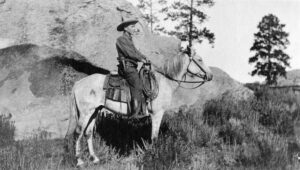
In his essay “Escudilla,” published in A Sand County Almanac in 1949, Leopold turned the death of Old Bigfoot into something larger than a field report. “The government trapper who took the grizzly,” he wrote, “knew he had made Escudilla safe for cows. He did not know he had toppled the spire off an edifice a-building since the morning stars sang together.”
Leopold described the trapper’s task in simple, haunting prose:
“The trapper packed his mule and headed for Escudilla. In a month, he was back, his mule staggering under a heavy hide. There was only one barn in town big enough to dry it on. He had tried traps, poison, and all his usual wiles to no avail. Then he had erected a set-gun in a defile through which only the bear could pass, and waited. The last grizzly walked into the string and shot himself,” Leopold wrote.
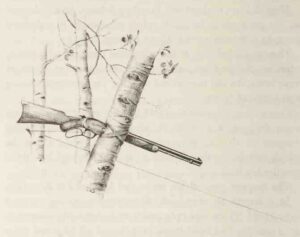
“It was June. The pelt was foul, patchy, and worthless. It seemed to us rather an insult to deny the last grizzly the chance to leave a good pelt as a memorial to his race. All he left was a skull in the National Museum, and a quarrel among scientists over the Latin name of the skull. It was only after we pondered on these things that we began to wonder who wrote the rules for progress,” Leopold wrote.
The story reads like a lament—a warning about what happens when wilderness is reduced to an economic commodity. For Leopold, the balance between progress and preservation was fragile: one direction meant prosperity; the other meant the extinction of the very keystone predators that held nature’s systems together.
“Conservation is a state of harmony between men and land. Harmony with land is like harmony with a friend; you cannot cherish his right hand and chop off his left. That is to say, you cannot love game and hate predators; you cannot conserve the waters and waste the ranges; you cannot build the forest and mine the farm. The land is one organism,” Aldo Leopold.
By the 1930s, predator control was standard policy across the West. Grizzlies, wolves, and mountain lions were hunted as threats to cattle as ranching expanded and settlers pushed into the high country. Leopold himself once believed in that mission, thinking he was serving the greater good. But years later, standing on Escudilla’s summit, he saw the cost. “Recreational development,” he later wrote, “is a job not of building roads into lovely country, but of building receptivity into the still unlovely human mind.”
Brown’s documentation shows how bounty systems and federal trappers eliminated grizzlies from the White Mountains, the Blue Range, and the Mogollon Rim throughout the early twentieth century. Another story—less verified—claims a grizzly was shot at Strayhorse, forty miles south, a year earlier. But among historians and biologists, Escudilla remains the final chapter.

The last grizzly bear in New Mexico in the Gila Wilderness area was killed in April 1931. There were a few undocumented accounts in the state up until the 1950s.
Probably one of the most famous grizzly bears ever killed in the American West was Old Mose, the legendary giant of Colorado’s Wet Mountains. For more than a decade, ranchers around Cañon City swapped stories of a huge, cunning boar that preyed on cattle and left behind a distinctive track—two toes missing from one hind foot, the scar of an old trap or gunshot wound. His legend grew with every sighting, until April 30, 1904, when rancher James Anthony and neighbor J. C. Escott finally cornered him near Four Mile Creek after a lengthy pursuit through the spring snow. The bear charged, and Anthony’s rifle brought him down. Old Mose was said to weigh close to a thousand pounds, though reports varied wildly. His skull went to the Smithsonian, his hide to Cañon City, and his story into frontier folklore—marking the end of Colorado’s great grizzlies and the rise of one of the West’s most enduring legends.
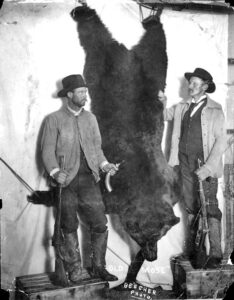
Picture Credit: Colorado Museum.
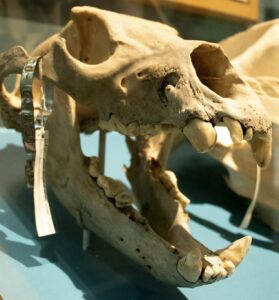
The last verified record of a grizzly in the Southwest came decades later, in 1979, when hunter Ed Wiseman was mauled while defending himself from a 400-pound sow (female) grizzly bear in Colorado’s San Juan Mountains. Wiseman stabbed the grizzly with his arrow during the mauling event and killed it. The event, later retold in Outdoor Life, revealed that grizzlies had persisted unseen long after experts had declared them extinct.
The remains of the 400-pound sow are on display at the Denver Museum of Nature and Science.
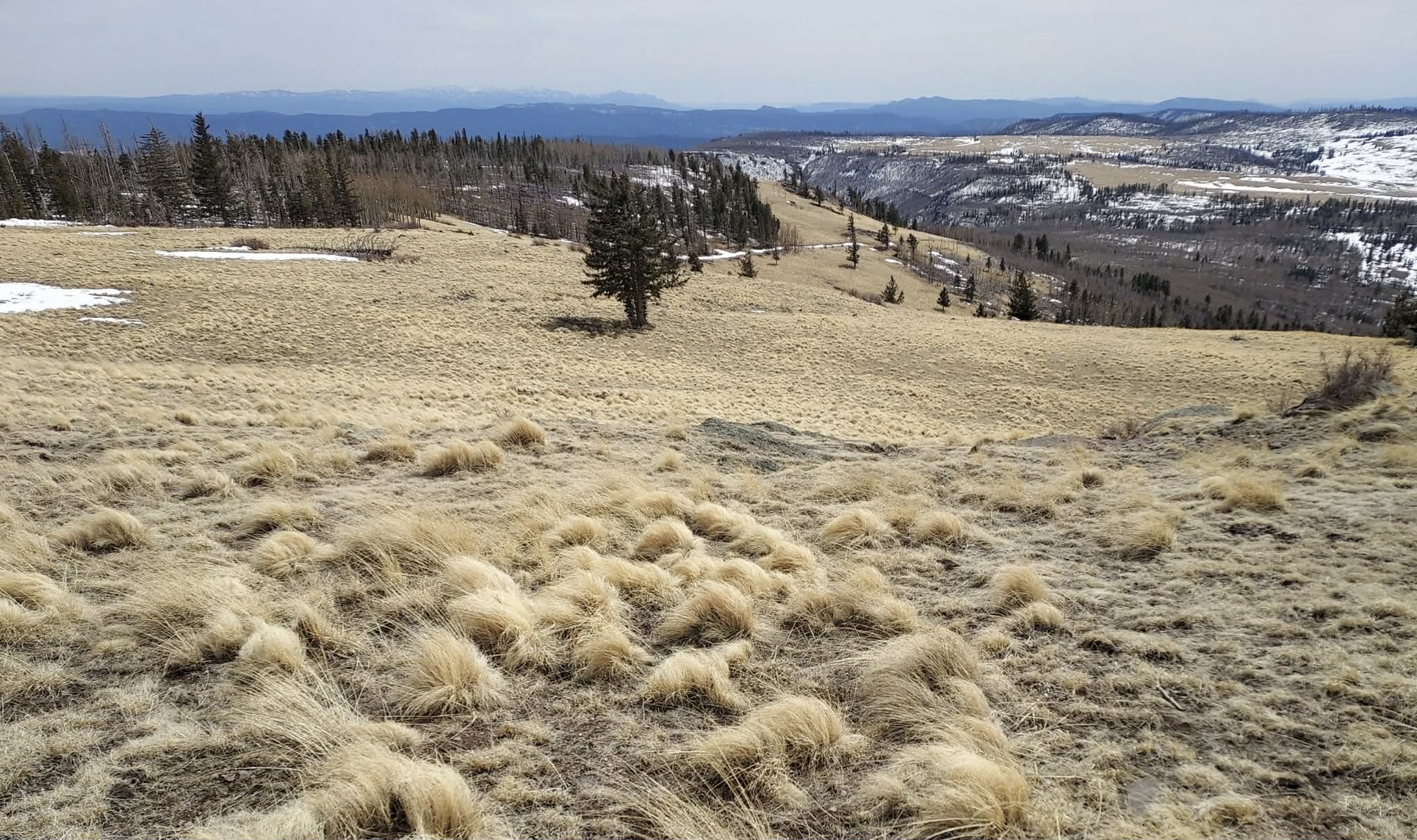
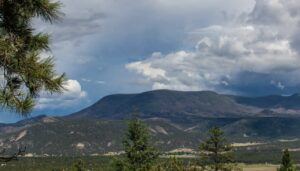
Today, Escudilla still stands high and bold, with a devouring magic felt and seen by many; some say it may put a spell on you. The area was scarred by the 2011 Wallow Fire, which swept across more than half a million acres of the Apache–Sitgreaves National Forests and burned much of the mountain’s western slopes. The fire left a patchwork of charred ridges and meadows, but nature is reclaiming the scars—young aspen now rise where old spruce and fir once stood.
Hikers who follow Trail 308 to the old lookout tower pass through this recovering forest, where elk graze in open clearings, wolves and black bear prosper, and summer storms build over distant mesas. They walk the same ground where Old Bigfoot once roamed. However, they will find no grizzly tracks now—only black bear sign and the quiet echo of a story that changed how Americans think about the wilderness through the lens of Leopold, and years of identifying the destruction driven by man.
The Case for Reintroduction
Nearly nine decades later, some conservationists argue that the story of the Southwest’s grizzly isn’t finished. Among them is George Wuerthner, an ecologist, photographer, and author of more than thirty books on ecology and natural history. Wuerthner believes that restoring grizzlies to Escudilla and the surrounding Gila–Mogollon country would be a moral and ecological act—an attempt to repair what human expansion destroyed.
“Escudilla alone would not be sufficient to sustain a grizzly population,” Wuerthner explained in an interview with the Mountain Daily Star. “But as part of a larger Greater Gila Ecosystem, you could sustain grizzlies.” He noted that it would take more than a few dozen bears to make a true ecological impact. “It would likely take a while because grizzlies have a low reproductive rate. You could augment the population with grizzlies from the northern Rockies.”
He added that where grizzlies and black bears overlap, black bears generally defer to the larger species. “The black bears attempt to avoid the grizzlies,” he said. “They might reduce the population of black bears, but black bears can climb trees—which grizzlies cannot.”
For Wuerthner, the argument is ultimately ethical: “We need to make amends to nature for all the ecological damage we humans have done. One way to do this is to restore native species that we eliminated. We have a moral obligation to heal the natural world.”
Though he concedes that the exact ecological outcomes are uncertain, he believes restoration would enrich ecosystems by creating carrion for scavengers, dispersing seeds, and rebalancing predator-prey relationships. “If we assume grizzlies had some ecological role in the past, then restoring them restores that balance—even if we don’t know exactly what that might be.”
The Case Against Reintroduction
While Wuerthner and other rewilding advocates see the grizzly’s return as an ecological and ethical restoration, some scientists remain skeptical. Ecologists such as David E. Brown, David Mattson, and Dr. Chris Servheen—all leading authorities on grizzly bear conservation—have long argued that Arizona’s present-day landscape cannot sustain a self-sufficient population.
Brown’s decades of fieldwork concluded that no remaining habitat in Arizona retains the combination of space, remoteness, and food base required for recovery. Mattson, a former U.S. Geological Survey researcher with the Interagency Grizzly Bear Study Team, found that viable populations depend on vast, connected core areas with minimal human disturbance—conditions that exist in Yellowstone or Glacier, but not on Escudilla or the White Mountains. Servheen, who led the U.S. Fish and Wildlife Service’s national recovery program for over thirty years, has noted that a genetically viable population requires at least 500 interconnected bears and broad, continuous corridors for dispersal.
Unlike the protected wilderness cores of the northern Rockies, the Escudilla and Blue Range landscapes are fragmented by roads, ranches, and small towns. Grizzlies need extensive home ranges—females typically occupy 300–900 square kilometers, while males may exceed 3,000 km²—and long-term survival depends on steady gene flow across intact habitat. Without that, any reintroduced bears would require constant human management.
Studies consistently show that grizzly survival declines sharply with road density and human access. Nearly all of Arizona’s remaining forest lands are multi-use—open to grazing, hunting, and recreation—creating a continual potential for conflict. Wildlife-management data from the northern Rockies indicate that livestock depredation often rises—sometimes doubling—where grizzlies and wolves overlap, a serious concern in Apache County’s cattle country.
Arizona also lacks the high-energy foods, such as whitebark pine nuts and salmon, that sustain northern populations. Any reintroduced bears would be forced to range widely in search of food, increasing the chance of human encounters.
Finally, restoration would require a new Endangered Species Act Section 10(j) experimental-population designation and decades of federal and state oversight, much like the Mexican gray wolf program. Biologists caution that introducing another apex carnivore would stretch limited resources and deepen local opposition.
For now, the scientific consensus remains clear: We humans have fragmented much of Arizona’s mountain ranges, leaving them too populated and too altered to support the grizzly that once ruled them.
Leopold’s “Escudilla” endures because it speaks to something larger than one mountain or one old bear. The essay reshaped conservation thought in the twentieth century, turning a nameless government trapper and Old Bigfoot into symbols of conscience.
Brown’s research, Leopold’s conscience, and Wuerthner’s moral compass gave that conscience a timeline and a place on the map. Together, they leave Arizona with a lesson: Every mountain is more than its usefulness to man. When we forget that, we lose something that cannot be trapped, measured, replaced, or built around.
For modern Arizona, that lesson lingers. The mission of Game and Fish—to balance predator control with conservation—reminds us that progress and preservation must walk the same trail, side by side, through the magical long shadow of Escudilla and the memory of the last Arizona grizzly, Old Bigfoot.
Our team of investigators is tracking down the skull of “Old Bigfoot.” If you have information about where it rests, email us at editor@mountaindailystar.com