In 1976, the United States celebrated something few Americans alive today had ever witnessed—our nation’s 200th birthday. This year, the United States is celebrating the 250th anniversary of the signing of the Declaration of Independence, known as the Semiquincentennial or America250.
In 1976, from coast to coast, communities were draped in red, white, and blue. Patriotic songs filled the air. Schools taught the principles of the Constitution and the sacrifices of those who founded the nation. For millions of Americans, the Bicentennial was more than a celebration—it was a renewed appreciation for the ideals that shaped the United States.
For one young girl growing up in the White Mountains of Arizona in 1976, it became a memory that would last a lifetime.
Kathy Gibson was just 13 years old and attended Capps Elementary School in Heber. Like students across America, she studied the Declaration of Independence, the Constitution, George Washington, Abraham Lincoln, and the pioneers who settled the American frontier. Her class was challenged to write an essay titled “What America Means to Me.” Nearly fifty years later, she still has that essay and proudly displays it in this article below.
But one experience from that year stands above all the others.
She and her classmates boarded a bus and traveled from the small mountain community of Heber to Tempe to visit one of the most remarkable traveling museums ever assembled—the American Freedom Train (click here for link).
For a young student who had only read about history in textbooks, suddenly history was right in front of her.
Gibson remembered stepping onto a slow-moving conveyor that carried them through ten exhibit cars containing more than 500 priceless artifacts from America’s first two centuries. The exhibits included George Washington’s copy of the Constitution, Abraham Lincoln’s stovepipe hat, Martin Luther King Jr.’s Bible and pulpit robe, a moon rock from the Apollo program, Judy Garland’s dress from The Wizard of Oz, sports memorabilia from Hank Aaron, and countless other treasures representing America’s political, military, scientific, artistic, and cultural history. More than seven million Americans would tour the train during its 21-month journey across the nation.
Although decades have passed, several displays remain vivid in her memory.
“I remember Abraham Lincoln’s top hat, George Washington’s copy of the Constitution, the Betsy Ross flag, and the Liberty Bell replica,” Gibson recalled. “It was something I’ll never forget.”
An Idea Born From Patriotism
The Freedom Train itself almost never happened.
The project was the vision of Ross Rowland Jr., a successful New York commodities broker and lifelong steam locomotive enthusiast. Concerned that Americans were becoming disconnected from their own history following the turmoil of the 1960s and early 1970s, Rowland envisioned a traveling museum that would bring the nation’s treasures directly to the people.
His close friend, John Wayne, encouraged the idea and became one of its strongest advocates.
Initial efforts to obtain federal funding were unsuccessful, forcing Rowland to seek private investment. After giving dozens of presentations, he secured Pepsi as the first major corporate sponsor and then secured additional financial support from businesses across the country.
The result became one of the largest privately funded patriotic celebrations in American history.
Steam, Steel, and American History
Beginning on April 1, 1975, the American Freedom Train traveled to all 48 contiguous states before concluding its journey on December 31, 1976.
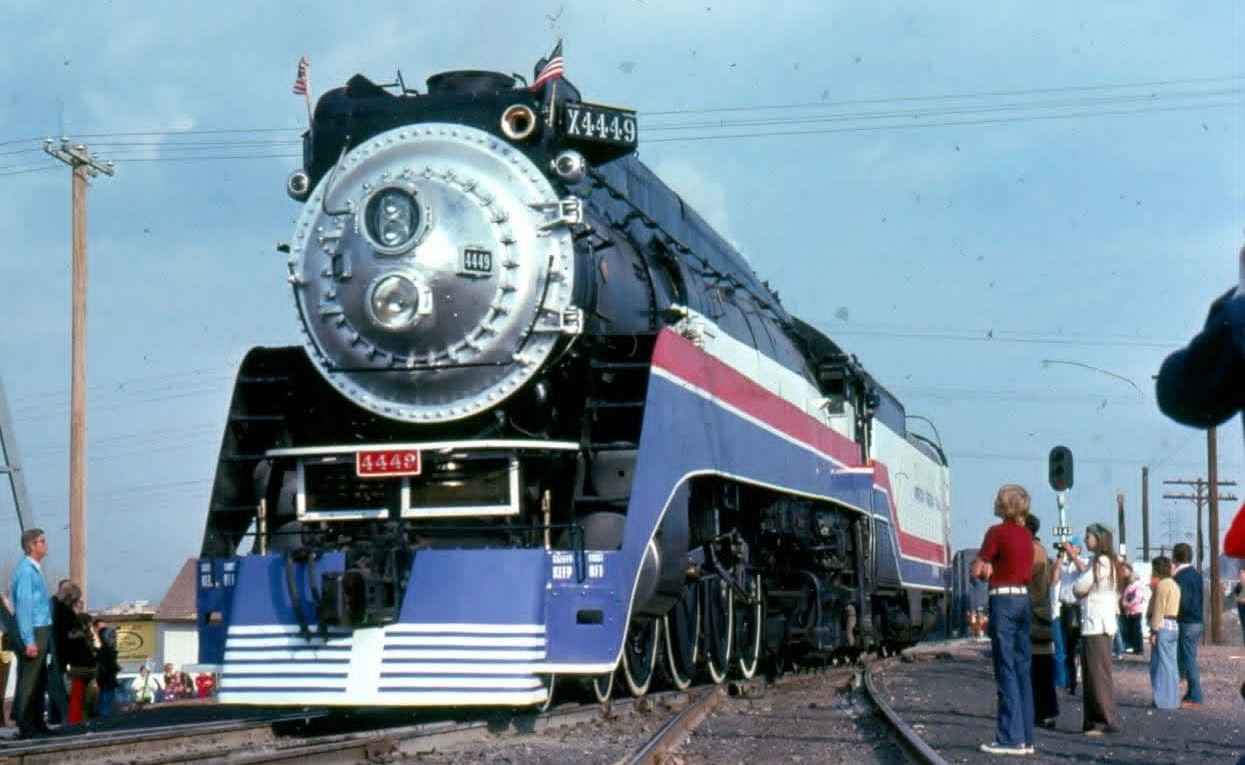
Three restored steam locomotives shared the responsibility of pulling the 26-car train across America. In the West—including Arizona—the beautifully restored Southern Pacific No. 4449 became one of the most photographed locomotives in American history as it carried the red, white, and blue train through communities large and small. Millions more lined railroad crossings simply to watch it pass.
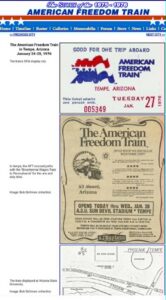
The Freedom Train stopped in Tempe on January 24, 1976, giving Arizona schoolchildren—including students from Heber—the opportunity to experience American history in a way few classroom lessons could ever match.
When Gibson stepped onto the Freedom Train, she experienced a historical event.
Preserving an Arizona Memory
While researching the Freedom Train years later, she discovered that Arizona railroad photographer Dwight Blackburn had photographed the iconic train during its Tempe stop.
She contacted Blackburn after finding his photographs on a steam locomotive enthusiasts’ page. He graciously granted permission for his images to be shared so others could remember—or discover for the first time—one of the greatest traveling exhibits in American history.
Those photographs now help tell a story that many younger Americans have never heard.
Looking Toward America’s 250th Birthday
As the United States begins celebrating its 250th anniversary, history is once again being brought directly to communities across the nation.
The America250 Foundation has announced the Freedom Truck (click link here), a traveling “Museum on Wheels” designed to bring interactive exhibits and stories of America’s founding directly to schools and communities. Rather than railcars, the exhibits travel by highway, continuing the same mission that inspired the Freedom Train nearly fifty years ago—to connect Americans with their shared history and the principles of liberty.
For those who walked through the Freedom Train as children, those memories have endured for a lifetime.
Sometimes history is learned from a book.
Sometimes it is preserved in a museum.
And sometimes, history comes rolling into town on the rails, reminding an entire generation what it means to be an American.
What America Meant to a 13-Year-Old in 1976
One of the most meaningful keepsakes from that Bicentennial year is the essay Gibson wrote as a 13-year-old student at Capps Elementary School.
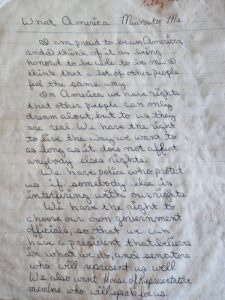
Titled “What America Means to Me,” the essay speaks of constitutional freedoms, the sacrifices of the Pilgrims, the struggles of the Civil War, and the privilege of American citizenship. Written from the perspective of a young student, it reflects both the optimism of the Bicentennial era and the lessons being taught in classrooms across the country.
Nearly fifty years later, the words remain a heartfelt reminder of what the Bicentennial meant to one Arizona student—and why the American Freedom Train left such a lasting impression. It also serves as a reminder that 50 years later, we are still a young Nation trying to spread freedom and peace, one generation at a time.
Comment on our Mountain Daily Star Facebook page and tell us “what America means to you.”
Kathy Gibson Boatman
We would like to thank Mr. Dwight Blackburn for giving us permission to use his Freedom Train Pictures.