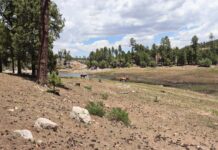
HEBER, Ariz. — A federal judge has limited a preliminary injunction to the Sitgreaves National Forest, ruling it no longer applies to the Apache National Forest after determining the challenged U.S. Forest Service actions were confined to the Sitgreaves. The ruling came days after the Center for Biological Diversity sought to intervene, arguing in court filings that unauthorized free-roaming horses had denuded portions of federally designated critical habitat for the endangered New Mexico meadow jumping mouse on the Apache National Forest.
We have covered the Heber Horse issue since the beginning. You can get caught up by visiting our website, Mountain Daily Star, and searching for “Heber Horses.”
The lawsuit was originally filed by the International Society for the Protection of Mustangs and Burros and Heber resident Betty Nixon in April. They challenged the Forest Service’s management of horses associated with the Heber Wild Horse Territory. The plaintiffs successfully obtained a preliminary injunction in July temporarily preventing the Forest Service from classifying unclaimed and unbranded horses as unauthorized livestock and removing them from the Apache and the Sitgreaves National Forests while the litigation continues.
In a unique action, on Aug.11, the Center for Biological Diversity and the Maricopa Bird Alliance filed a 60-page motion to intervene and be named as defendants, requesting that the preliminary injunction exclude the Apache National Forest, aligning with the U.S. Department of Agriculture, the U.S. Forest Service, and the other federal defendants.
The organizations argued that the July 8 preliminary injunction extended beyond the original dispute involving the Sitgreaves National Forest and unintentionally affected horse management on portions of the Apache National Forest that contain federally designated critical habitat for the endangered New Mexico meadow jumping mouse.
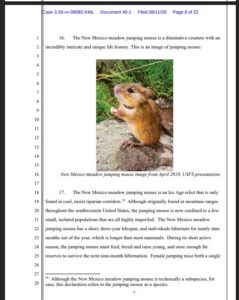
The conservation groups emphasized they were not asking the court to dissolve the preliminary injunction. Instead, they requested that it be modified so the Forest Service could continue removing unauthorized horses from designated jumping mouse habitat where such removals are necessary to comply with the Endangered Species Act, while leaving the injunction for the free-roaming horses on the Sitgreaves National Forest intact.
According to the motion, the Center has spent nearly two decades working to protect the New Mexico meadow jumping mouse and its habitat. The filing outlines the organization’s involvement in efforts that contributed to the species being listed as endangered in 2014, designation of critical habitat in 2016, a 2020 Endangered Species Act lawsuit, and a 2021 settlement agreement requiring the Forest Service to inspect protective fencing and remove unauthorized livestock from portions of designated habitat on the Apache National Forest.
Supporting the motion was a 22-page sworn declaration from Dr. Robin Silver, co-founder and board member of the Center for Biological Diversity and vice president of the Maricopa Bird Alliance.
According to Silver’s declaration, the earlier Endangered Species Act litigation focused on unauthorized horses in the Black River watershed of the Apache National Forest—not the Heber Wild Horse Territory. Silver stated that after the 2011 Wallow Fire destroyed portions of the boundary fence between the White Mountain Apache Reservation and the Apache National Forest, horses entered federally designated habitat for the endangered New Mexico meadow jumping mouse.
Silver stated the White Mountain Apache Tribe later removed trespass cattle but did not reclaim the horses, which the Forest Service subsequently classified as unauthorized livestock. He contended those horses grazed streamside vegetation, trampled riparian areas, and left portions of designated critical habitat denuded before removal efforts began.
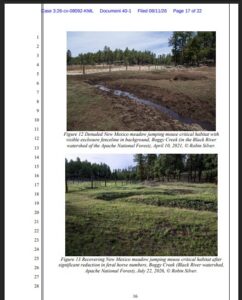
Silver described years of field visits throughout the Black River watershed, during which he documented habitat conditions before and after reductions in the number of unauthorized horses. His declaration includes photographs from Boggy Creek, Thompson Ranch, and the East and West Forks of the Black River, which he says show healthy habitat, habitat occupied by horses, and recovering habitat following significant reductions in the number of unauthorized horses.
The declaration also includes before-and-after photographs from Boggy Creek taken between 2021 and 2026. Silver identifies the 2021 images as depicting what he calls “denuded New Mexico meadow jumping mouse critical habitat,” while the 2026 photographs are presented as showing recovering riparian vegetation after horse removals. The Center argued the photographs demonstrate why the Forest Service should retain authority to remove unauthorized horses from designated critical habitat on the Apache National Forest while the broader lawsuit continues.
Silver also cited a 2022 decision by U.S. District Judge Jennifer G. Zipps, who concluded the Forest Service had presented evidence that certain horses on the Apache National Forest were not descendants of horses that were wild and free-roaming on public lands in 1971 and upheld the agency’s authority to classify those animals as unauthorized livestock. Silver argued that decision, together with U.S. Fish and Wildlife Service recovery documents, demonstrates the importance of continued habitat protection.
The motion argued the Center had a direct legal interest in the case because the preliminary injunction could interfere with ongoing efforts to protect critical habitat in the Black River watershed. It also contended the federal defendants could not adequately represent the Center’s interests because they must balance multiple statutory obligations, while the Center intended to focus specifically on enforcement of the Endangered Species Act.
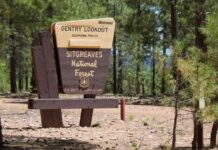
Then, on Aug. 13, U.S. District Judge Krissa M. Lanham granted the U.S. Forest Service’s motion to clarify or modify the court’s July 8 preliminary injunction, concluding the challenged agency actions—including the January 2026 Heber Wild Horse Territory Management Plan, the March 2026 unauthorized livestock determination, and the April 2026 removal notice—applied only to horses on the Sitgreaves National Forest.
Although the court’s earlier order referred to the “Apache-Sitgreaves National Forests,” Judge Lanham concluded the record supported limiting the injunction to the Sitgreaves National Forest. The judge also observed that the Forest Service “was not clear about the separate horse populations and at times used ‘Apache-Sitgreaves’ inartfully,” contributing to confusion over the injunction’s geographic scope.
As modified, the injunction now applies only to the Sitgreaves National Forest, including the Heber Wild Horse Territory and the Black Mesa and Lakeside Ranger Districts. The order no longer restricts the Forest Service’s authority to manage unauthorized horses on the Apache National Forest while the lawsuit proceeds.
Judge Lanham ultimately concluded that once the injunction was modified to apply only to the Sitgreaves National Forest, the Center’s concern regarding horse removals on the Apache National Forest had been addressed. The court denied the motion to intervene without prejudice as moot, and allowed the Center for Biological Diversity and the Maricopa Bird Alliance 7 days to renew their request if they believe they continue to have a legal interest in the litigation.
The litigation will continue on the Sitgreaves National Forest, and we will keep you updated on the case.