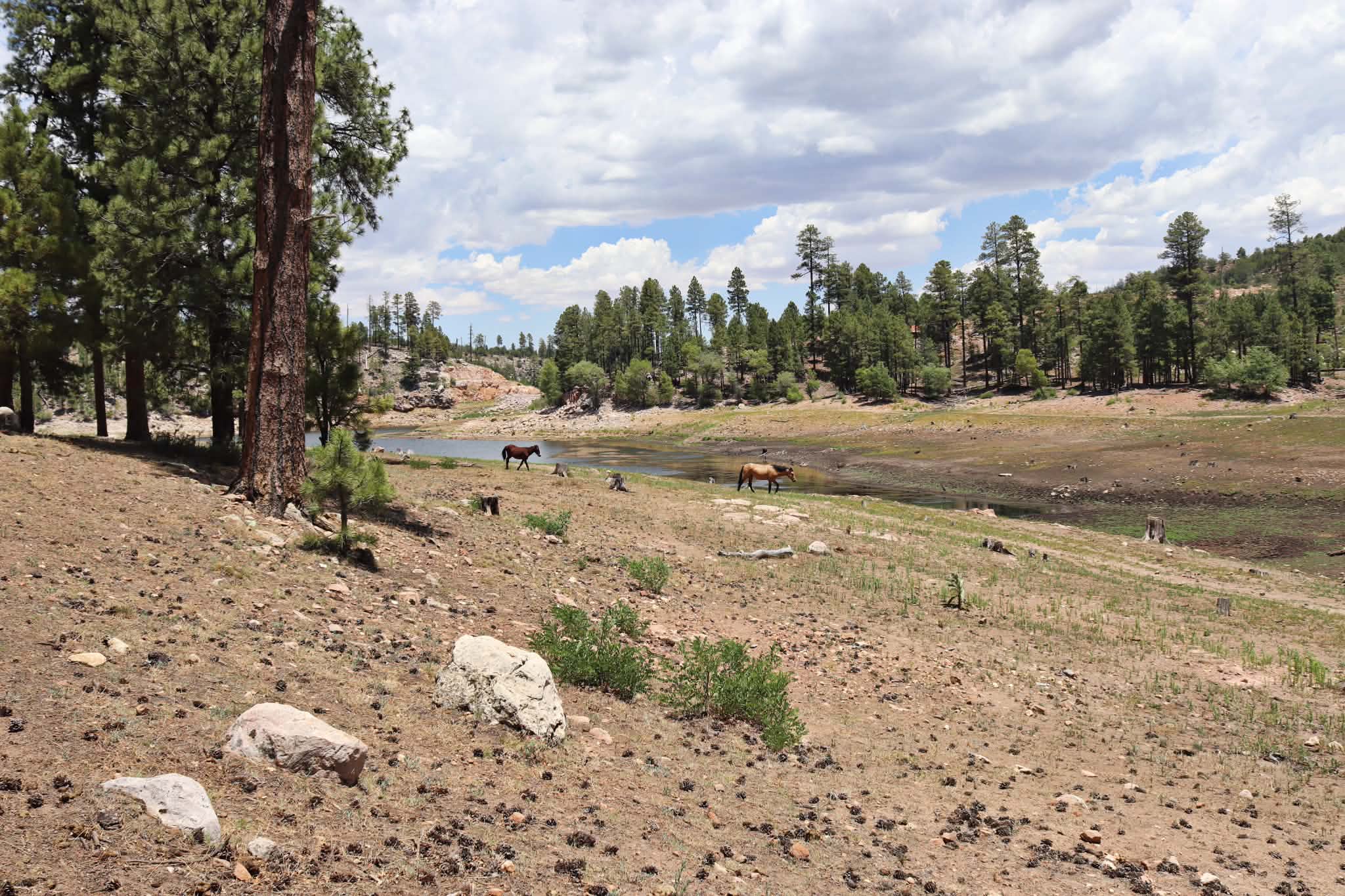
HEBER, Ariz.— A federal judge has temporarily blocked the U.S. Forest Service from capturing or removing unclaimed and unbranded horses from the Apache-Sitgreaves National Forests after concluding that the plaintiffs met the legal standard for a preliminary injunction while their lawsuit challenging the agency’s actions proceeds.
The lawsuit was filed by the International Society for the Protection of Mustangs and Burros (ISPMB), Karen Sussman, and Betty Nixon, a resident of Heber, Arizona, who contend the Forest Service unlawfully reclassified unclaimed and unbranded horses on the Apache-Sitgreaves National Forests as “unauthorized livestock” rather than federally protected wild free-roaming horses.
In a 12-page order issued July 8, U.S. District Judge Krissa M. Lanham found the plaintiffs demonstrated they are likely to succeed on the merits of at least one claim. According to the document, the judge wrote that she believes they (the public, local residents, Nixon and ISPMB) are likely to suffer irreparable harm in the absence of preliminary relief, that the balance of equities tips in their favor, and that an injunction is in the public interest to protect and allow the horses to remain on the Apache Sitgreaves National Forests in their present state.
The court also found the plaintiffs had standing to pursue their claims.
Judge Lanham wrote that the Forest Service’s April 2026 determination classified unclaimed and unbranded horses throughout the Apache-Sitgreaves National Forests as unauthorized livestock, making an injunction limited to the Heber Territory inadequate. The court concluded that because the challenged agency action applied forest-wide, the preliminary injunction should likewise apply throughout the Apache-Sitgreaves National Forests. Enjoining the horses presently on the Apache National Forest with the Sitgreaves National Forest. Therefore, both national forests are enjoined in the preliminary injunction.
It’s important to note that the litigation regarding the capture of horses in the Apache National Forest was resolved in 2022. And removal was completed after a couple of years.
The order restrains the Forest Service, its officers, agents, servants, employees, attorneys, and all persons acting in active concert or participation with them, from determining that unclaimed and unbranded horses are “unauthorized livestock,” “strays,” or “feral” rather than wild free-roaming horses, and all above are restrined from capturing or removing those horses while the injunction remains in effect. The agency must also maintain its public notice regarding third-party horse roundups.
Judge Lanham emphasized that the preliminary injunction is intended to preserve the status quo and is not a final decision on the merits of the lawsuit. As the case proceeds, the court will review the complete administrative record to determine whether the Forest Service acted lawfully in concluding that the horses were unauthorized livestock rather than federally protected wild, free-roaming horses.
The court will also determine whether the agency complied with the Wild Free-Roaming Horses and Burros Act, the National Environmental Policy Act (NEPA), and the Administrative Procedure Act (APA) in issuing its March 2026 status determination and subsequent actions. Among the issues expected to be examined are whether the Forest Service’s decision was supported by the administrative record, whether the agency adequately explained its conclusions, whether it followed the procedures required by federal law before reclassifying the horses, and whether its actions were arbitrary, capricious, an abuse of discretion, or otherwise not in accordance with law. Until those questions are resolved, the preliminary injunction shall remain in effect until further order of the court.
The preliminary injunction proceedings also addressed the issue of a Rule 65 security bond. In filings before the court, the plaintiffs stated they are represented pro bono and argued that requiring them to post a bond would effectively deny access to judicial review in what they described as a public-interest environmental case. They cited federal case law recognizing that courts have discretion to waive or require only a nominal bond in environmental public-interest litigation and argued the federal defendants did not dispute that position in their response.
The plaintiffs’ pro bono representation means they are not paying their attorneys out of pocket during the litigation. If they ultimately prevail and satisfy the requirements of the Equal Access to Justice Act (EAJA) or another applicable fee-shifting statute, their attorneys may seek an award of reasonable attorneys’ fees from the federal government. Any such award would be paid from public funds by the responsible federal agency rather than by the plaintiffs themselves. However, any recovery of attorneys’ fees is not automatic and would depend on the plaintiffs prevailing in the case and meeting the statutory requirements, including a determination that the government’s position was not “substantially justified.”
The lawsuit filed by Karen Sussman (ISMB) and Nixon could take years to figure out; for now, the horses on the Apache-Sitgreaves National Forests will not be managed by the USFS or anyone else; they are free to roam in their current state with no oversight.