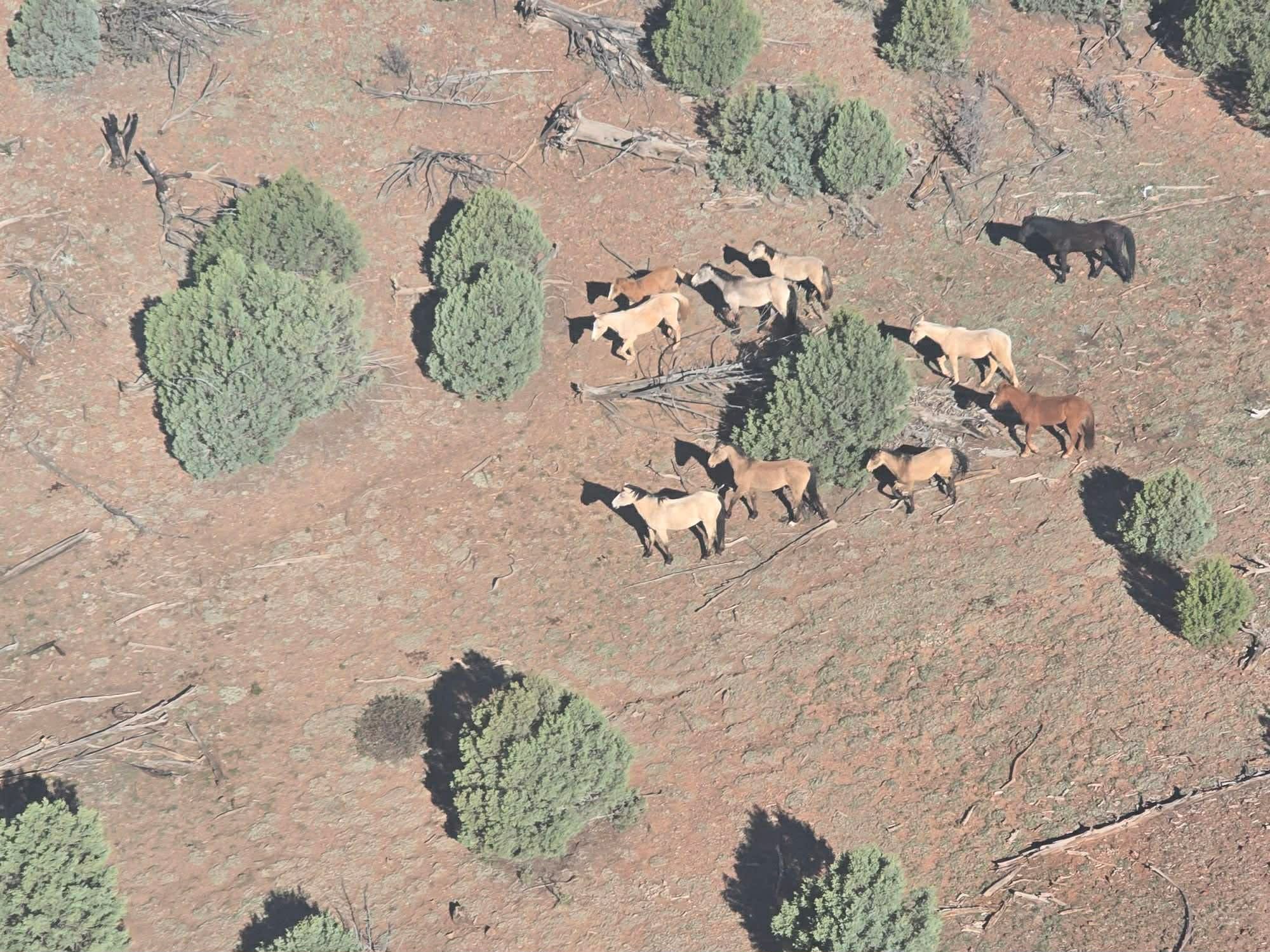
A decades-long conflict over free-roaming horses in Heber/Overgaard and surrounding areas in northeastern Arizona is reaching a turning point, as federal officials prepare to begin enforcement actions that could significantly reduce horse populations across the Apache-Sitgreaves National Forests. This article examines the question now facing the region: How did we get here?
The U.S. Forest Service issued a Notice of Intent to Impound Unauthorized Livestock on April 2, 2026, setting an April 27 deadline after which certain livestock may be seized and removed from national forest lands. The notice, signed in Springerville by Acting Forest Supervisor Joshua Miller, signals that a federally approved plan to reduce horse populations is now moving into the implementation phase.

The Forest Service confirmed to Mountain Daily Star that the notice has been posted in several county buildings and will be circulated.
The action follows years of environmental analysis, litigation, and public debate, culminating in a January 29, 2026, Final Decision Notice that established a population cap of 50 to 104 horses within the Heber Wild Horse Territory and authorized the removal of animals deemed “excess” or classified as unauthorized livestock.
But the roots of the current situation stretch back more than two decades, shaped in large part by two of Arizona’s most significant wildfires.
When the Heber Wild Horse Territory was established in the early 1970s, the entire known herd consisted of just seven horses—six mares and one stallion. That small group never developed into a sustainable population. Forest Service records indicate the herd remained stagnant for years, with little to no reproduction. A severe winter is believed to have left the stallion sterile, effectively preventing the herd from producing foals and growing beyond its original size.
By the 1990s, the population had dwindled to only two mares, which are believed to have died of old age, marking the end of the original herd. Federal findings conclude that this initial population did not survive into the present day, meaning today’s horses are not directly descended from those first seven horses. Instead, the current population appears to have formed later, largely from horses that moved into the forest from surrounding areas after fence failures and environmental changes reshaping the landscape.
The Rodeo-Chediski Fire burned approximately 460,000 acres across the Apache-Sitgreaves National Forest and the Fort Apache Reservation, destroying large portions of fencing that had long separated tribal lands from federal forest lands. In the years that followed, those fences remained compromised. Deadfall from burned trees repeatedly damaged repairs, leaving what officials described as “no effective barrier” between the two areas.
As a result, horses began moving more freely between tribal land and the national forest. At the same time, post-fire rehabilitation efforts introduced new grass and forage, creating attractive feeding areas. Horses spread into these newly vegetated zones, establishing themselves more permanently across portions of the forest.
By 2005, the Forest Service had identified an increase in horse populations and initiated efforts to gather and remove unauthorized livestock, but those efforts were halted when a lawsuit was filed, delaying management action for years.
In 2005, the forest service determined that the horse territory failed. Its designation as a horse territory failed because it could not sustain the population due to drought and a lack of forage and water resources. However, the horses remained due to lawsuits.
Nearly a decade later, in 2011, the Wallow Fire further altered the landscape. Like the Rodeo-Chediski fire, the Wallow Fire burned vast portions of both federal forest land and the White Mountain Apache Tribal lands, again damaging fencing and expanding pathways for horse movement. Wildlife and conservation groups say the second fire compounded the earlier effects, accelerating the migration of horses into sensitive areas of the national forest, including riparian habitats critical to species such as the New Mexico meadow jumping mouse and Apache trout.
Aerial surveys conducted by the Forest Service in May 2014, February 2015, and April 2017 provide the earliest detailed picture of horse numbers across the Sitgreaves National Forest. Using standardized flight patterns and statistical methods, biologists estimated horse populations both inside and outside the Heber Wild Horse Territory. Within the territory itself, survey estimates ranged from approximately 16 to 51 horses. Outside the territory, however, the numbers were significantly higher, estimated at roughly 177 to 420 horses across the surrounding forest lands.
The surveys were conducted using repeatable protocols, including photo mark-recapture techniques within the territory and simultaneous double-count methods outside it, allowing results to be directly compared across years. The data showed not only a consistently larger population outside the designated territory, but also an upward trend over time, reinforcing concerns that horse numbers were expanding well beyond the area’s carrying capacity. Those findings became a central basis for the Forest Service’s determination that the overall population far exceeded what the landscape could sustainably support.
A private aerial survey conducted in late March 2026 on the Sitgreaves National Forest by federal contractor Jackie Hughes of Rail Lazy H Contracting and Consulting LLC estimated approximately 1,800 horses in the area, with a potential increase of up to 30% to account for animals that may have been obscured beneath the forest canopy.
The March 2006 aerial survey was funded by Conservation First USA, a non-profit organization launched by volunteer sportsmen and women that raises funds to improve and restore wildlife habitat in the Southwest.

“Our concern has been the degradation of habitat, the silting of stock tanks, and the displacement of native wildlife by the horses,” said John Koleszar of Conservation First USA. “There has also been a reduction in elk permits in areas where the Heber horses are present, as native species are being pushed out by the growing horse population.”
A coalition of sportsmen and conservation organizations—including the Center for Biological Diversity, Arizona Sportsmen for Wildlife Conservation, and more than 30 affiliated groups, including local ranchers—has publicly supported the humane removal of what they describe as feral horses. These groups argue that the population surge following wildfire-related migration has caused measurable damage to habitat, particularly in riparian zones.
“The habitat degradation caused by the Heber horses is severe, and removal is the only means of rebuilding these areas for all wildlife,” said Dr. Robin Silver with the Center for Biological Diversity. “As we have seen on the Apache National Forest, if horses are not removed, streamside vegetation is destroyed. Horses are not native species; their reproductive capacity is high, and there are no natural predators to control their population. We have no choice but to remove them to protect and restore these areas of the forest.”
Groups supporting the removal of the horses present a sharply different view from horse advocates. Those opposed to removal say the horses belong in the Heber landscape and should remain there. Many advocates have made it clear they want the horses to stay and are pushing back against efforts to reduce or remove the herd.
Hughes said, “We don’t have animal problems, we have people problems, and the animals are suffering the consequences of it.”
Hughes emphasized that many horses living in the landscape today descended from domesticated animals and have adapted to survive in environments they were never intended to inhabit. She warns that decisions driven by emotion or politics—on either side—risk overlooking the long-term welfare of the animals themselves.
Hughes, speaking in an in-depth interview that will be featured in Free-Roaming Arizona Horses- Episode 2, said, “The horse helped build America, carrying human progress as a beast of burden in transport, agriculture, and even the mining industry, pulling carts through some of the nation’s hardest labor. Then the motor replaced the horse, and many were cast aside—turned loose on a landscape they were never meant to navigate alone. Because we brought them here to serve our needs, it is our responsibility to do right by them. Instead, they have reproduced and gone unmanaged, not out of design, but out of a lingering attachment to what they once meant to human survival and ingenuity.
Managing horses through emotion and political tactics rather than scientific evidence and facts only deepens the problem. It leads to overgrazing, damaged ecosystems, and ultimately poorer health for the horses themselves. These animals have adapted to a feral existence, but adaptation is not the same as thriving. Leaving them to struggle is not compassion; it is abandonment. Real responsibility means proper management, grounded in empirical evidence, while still respecting the horse’s place in our history. The question is not whether we care about horses; it’s whether we care enough to act on truth instead of sentiment, and ensure they are managed humanely, sustainably, and with the dignity and grace they earned by helping build this country,”
She emphasized that the future of these horses depends on responsible, fact-driven decisions rather than emotion alone.

Under the agency’s framework, horses that do not meet the legal definition of wild free-roaming horses can be classified as unauthorized livestock and removed under federal grazing regulations. The Forest Service evaluates factors such as branding, location, herd behavior, and historical origin to make that determination. The April 2 notice does not declare all horses trespassing, but it signals that animals falling into that unauthorized category will be subject to enforcement after April 27.
After that date, federal officials and federal contractors may begin impounding animals identified as unauthorized livestock. Owners will have a limited window to reclaim them by paying the associated costs, while unclaimed animals may be sold, relocated, or otherwise disposed of. At the same time, broader herd reduction efforts authorized under the management plan are expected to move forward, using bait trapping, helicopter-assisted gathers, and fertility control measures, supported by new holding facilities and infrastructure.
The Forest Service ultimately set an Appropriate Management Level of 50 to 104 horses within the approximately 19,700-acre Heber Wild Horse Territory, citing concerns over forage availability, water resources, and impacts to wildlife habitat.
Under the approved plan, removal efforts will begin with horses located outside the territory and, if necessary, move inward. If reductions beyond the boundary are insufficient, horses within the territory itself may also be removed.
The current situation reflects a convergence of environmental change, federal policy, and competing values. The Rodeo-Chediski Fire broke down the barriers. The Wallow Fire expanded the pathway. What followed was a steady increase in horse movement and population growth, and ultimately, federal intervention to save the precious natural resources that many Arizonians have devoted generations to protecting.
Now that enforcement is set to begin, the issue is no longer theoretical—it is unfolding in real time. It is playing out across a landscape shaped by fire, and within a debate defined by fundamentally different views of what the horses represent, and the responsibility humans now carry for the future of the land, native species, and the horses themselves