FLAGSTAFF — Federal investigators say there is no evidence that gunfire struck an Arizona Department of Public Safety helicopter that crashed during an active-shooter response in Flagstaff earlier this year, killing two crew members.
A newly released preliminary report from the National Transportation Safety Board (NTSB) reconstructs the helicopter’s final flight, revealing that the aircraft suddenly entered a rapid rotation before crashing, and that investigators found evidence that the main rotor blades struck the tail section during the breakup sequence.
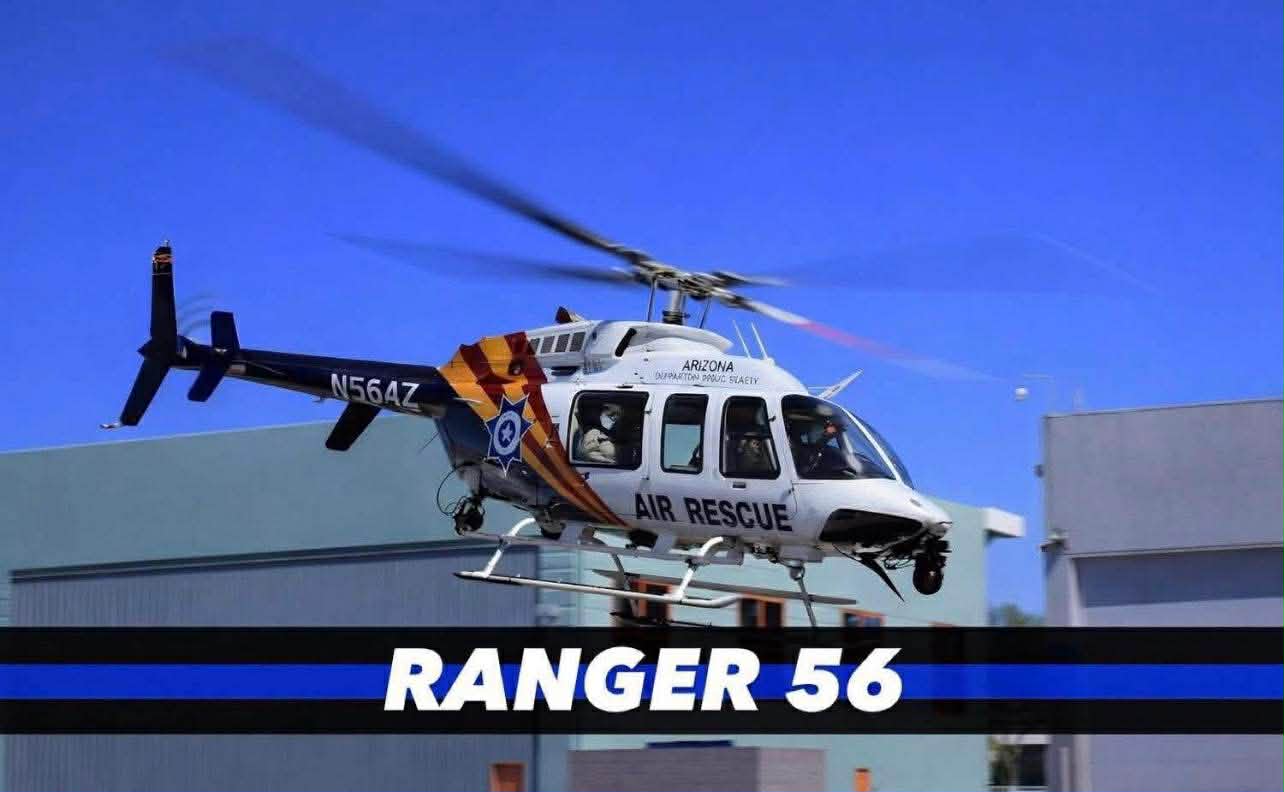
The Bell 407 helicopter, registration N56AZ, crashed at approximately 10:16 p.m. on Feb. 4, 2026, while assisting law enforcement during a shooting incident in a neighborhood southeast of downtown Flagstaff.
The helicopter was operated by the Arizona Department of Public Safety. The crash claimed the lives of pilot Robert Bruce Skankey and tactical flight officer Hunter Ray Bennett, who were assisting officers on the ground during the response to the active-shooter incident.
The NTSB report states that the crew began their shift at 8 a.m. and had already completed a rescue mission before receiving a request to respond to the active-shooter incident. The aircraft departed from Kingman at about 9:10 p.m. and traveled east toward Flagstaff.
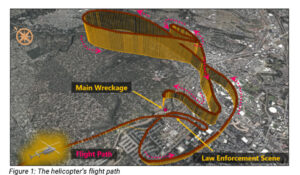
Federal Aviation Administration tracking data, along with video and audio from body cameras and nearby security cameras, show the helicopter descending to between 300 and 500 feet above ground level while circling the neighborhood as officers searched for the suspect. The tactical flight officer was seated in the left front seat and was operating the helicopter’s forward-looking infrared camera to assist officers.
The NTSB report states that at 10:12 p.m., the helicopter climbed north of the neighborhood and performed a left 180-degree turn to maintain separation from another helicopter that was inbound to Flagstaff Medical Center. At about 9,950 feet above mean sea level, the aircraft passed near the hospital-bound helicopter before turning back toward the law-enforcement scene.
Investigators said the helicopter then performed a left 360-degree turn and began descending to about 8,900 feet while returning toward the area where officers were responding.
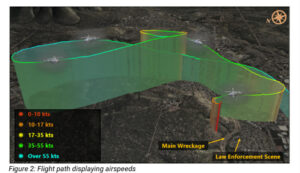
At 10:16:24 p.m., the tactical flight officer transmitted a radio call to officers on the ground. According to the preliminary report, there were no indications of any problems during the communication.
Less than 20 seconds later, video evidence shows the helicopter beginning a sudden and rapid rotation to the right.
“The rotation coincided with an unidentified verbal sound on the radio, followed by two loud banging sounds from the helicopter,” the report states.
Seconds later, the helicopter descended rapidly toward the ground.
During the descent, the aircraft’s searchlight was seen flashing repeatedly, which investigators said was consistent with the helicopter continuing to rotate.
The tactical flight officer then transmitted a final radio message stating, “We’re going down.”
The wreckage was later located about three nautical miles north of Flagstaff Pulliam Airport at an elevation of approximately 7,010 feet.
Investigators documented a debris field extending along a path of about 250 degrees, with some wreckage located more than 6,150 feet from the main impact site.
The main wreckage, consisting of the cockpit, cabin, and aft fuselage, came to rest on its right side and exhibited extensive post-crash fire damage.
Investigators reported that damage to the helicopter’s tail section was consistent with contact from the main rotor blades.
“The tailboom and the upper portion of the vertical fin exhibited multiple impact marks and punctures consistent with main rotor blade strikes sustained during the separation sequence,” the report states.
The main rotor hub, transmission, and three rotor blades were discovered about 165 feet south of the main wreckage.
“The main rotor hub, main rotor transmission, and three main rotor blades were located about 165 ft south of the main wreckage,” investigators wrote in the report.

Despite the helicopter responding to an active-shooter incident, investigators said there was no evidence the aircraft had been struck by gunfire.
“Postaccident examination of the helicopter revealed no evidence of ballistic punctures,” the report states.
Flight-tracking data also showed the helicopter was approximately 7,500 feet away from the suspect when shots were fired.
The helicopter’s engine control unit was recovered from the wreckage, and investigators successfully downloaded its data. The data indicated the engine was operating at high power prior to the accident and that rotor speed remained stable until the breakup sequence began.
Weather conditions at the time were reported as clear with 10 miles of visibility and light winds of about 3 knots. The temperature was approximately 2 degrees Celsius. The moon was nearly full and about 11 degrees above the horizon.
The pilot had accumulated more than 3,500 hours of civilian helicopter flight time and previously served as a Marine Corps helicopter pilot from 1988 to 2010, including time assigned to Marine Helicopter Squadron One.
The investigation is being led by the National Transportation Safety Board with assistance from the Federal Aviation Administration, Bell Helicopter, Rolls-Royce, and the Arizona Department of Public Safety.
Officials emphasized that the report is preliminary and that findings may change as investigators continue their analysis. A final report determining the probable cause of the crash may take one to two years to complete.