HEBER, Ariz. — Federal court filings are increasingly undermining claims advanced by horse activists and the International Society for the Protection of Mustangs and Burros. The court record highlights decades of scientific analysis and historical documentation by the U.S. Forest Service, while recent declarations reveal representatives connected to White Mountain Apache livestock associations are now seeking recovery of their horses displaced from Tribal Land following the Rodeo-Chediski Fire.
For years, activists portrayed the Forest Service and its private contractors as villains in a vicious social media narrative built around outrage, accusations, and emotional slogans. But the actual federal filings now emerging from court show an agency that has spent decades documenting horse populations, conducting environmental analyses, reviewing historical records, monitoring ecological conditions, coordinating with stakeholders, and attempting to navigate one of the most politically explosive public-lands issues in Arizona.
The case, International Society for the Protection of Mustangs and Burros, et al. v. United States Government, et al., Case No. 3:26-cv-08092-KML, is currently pending in the United States District Court for the District of Arizona before U.S. Magistrate Judge Krissa M. Lanham.
The federal record reflects that the Forest Service has taken decades to document the issues on the Sitgreaves National Forest.
According to federal declarations and reports cited in the litigation, the Forest Service has been documenting horse numbers in the Heber Wild Horse Territory since the 1970s. Historical reports to Congress allegedly tracked the original herd for decades, documenting a tiny population of six mares and one sterile stallion with no successful reproduction identified between 1969 and 1993.
Federal records cited in the filings state the herd dwindled to two elderly mares by 1993 before reports to Congress documented zero horses in both 1994 and 1996.
Those records matter because they directly contradict years of activist rhetoric that suggests the Forest Service suddenly “invented” concerns about the origin and condition of the current horse population on the Sitgreaves National Forest.
Instead, the filings show the agency has been grappling with these attacks for decades.
The filings also reveal the Forest Service did not simply rush into removals after the Rodeo-Chediski Fire. In fact, when litigation erupted in 2005, the Forest Service entered into a 2007 stipulation agreement that paused horse removals while the agency conducted years of additional environmental analysis and public process.
That process involved:
- Environmental assessments
- Public comment periods
- Territory management planning
- Historical analysis
- Ecological monitoring
- Extensive review of horse status determinations
The filings also reference a 2017 ethnographic study conducted by Forest Service historians that examined the lineage and history of the horses currently occupying the forest.
Buried deep within the growing stack of federal filings in the Heber horse litigation is a document that may ultimately become one of the most important pieces of the entire case: a 2017 ethnographic study conducted during the U.S. Forest Service’s long-running review of the Heber Wild Horse Territory.
“Enterprise Heritage’s Historian conducted record searches and interviews of individuals to determine the history of the Heber Wild Horse Territory and the horses within.”
The study is now being cited directly by the federal government in its argument that the horses currently roaming on portions of the Apache-Sitgreaves National Forests are not descendants of the original protected Heber herd recognized under the Wild Free-Roaming Horses and Burros Act.
That conclusion strikes at the very center of the lawsuit filed by Betty Nixon and the International Society for the Protection of Mustangs and Burros. Their case depends heavily on the argument that the current horse population represents a continuously protected historic wild herd dating back to the original Heber Wild Horse Territory.
Perhaps the most politically explosive development in the federal filings involves representatives connected to White Mountain Apache livestock associations. According to sworn declarations, Milson Cromwell of the White Mountain Apache Tribe Cibecue Livestock Association met with Forest Service officials regarding recovery of horses allegedly displaced from Tribal Land following the Rodeo-Chediski Fire. The filings state that Cromwell later submitted an affidavit attesting that members of the livestock association identified horses bearing brands and markings associated with local Apache livestock owners and families. A similar affidavit was reportedly submitted by Lorenco Gooday of the Oak Creek Livestock Association. The declarations significantly strengthen the Forest Service’s position that at least portions of the current horse population originated as displaced livestock rather than a continuously protected historic wild herd.
Those declarations further support the Forest Service’s position that the current horse population originated from displaced livestock rather than a continuously protected wild herd.
Bullmore declaration. Nixon reports to the Sheriff and the Apache Tribe.
According to Matthew Bullmore, District Ranger for the Black Mesa Ranger District on the Apache-Sitgreaves National Forests, Nixon repeatedly accused ranchers and private individuals of illegally removing horses from the forest. However, Bullmore states follow-up investigations by Navajo County Sheriff’s Office deputies revealed the horses involved were claimed as privately owned livestock. Other incidents reportedly involved saddle horses or horses allegedly belonging to local landowners.
The filings further reveal that Forest Service personnel met with Nixon to explain the impound process, legal timelines, and the agency’s determination that the horses involved were classified as unauthorized livestock under federal regulations rather than as protected wild horses.
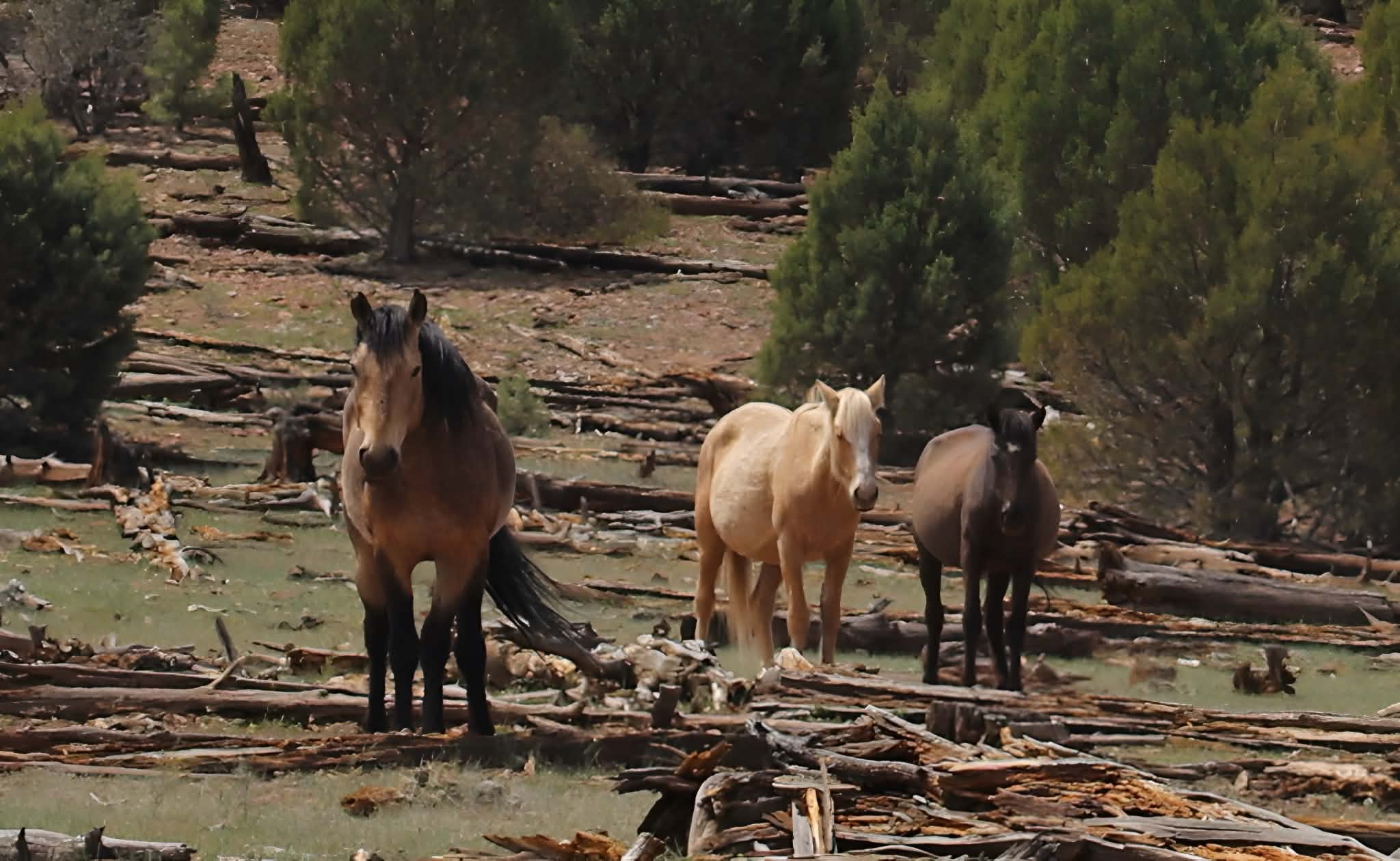
In addition to the facts, Forest Service personnel conducted body-condition assessments of horses in 2025 and documented that approximately 21 percent of surveyed horses had a body condition score of 3 or below.
Veterinary measurements aligned with recognized equine body-condition scoring systems were used to determine the condition of the Heber horses.
Those are not political talking points; it’s a matter of life and death for the horses.
The science is clear, the horses are starving, competing for resources, and some will now have to face possible euthanasia because the Forest Service and their contractors had their hands tied due to lawsuits and activists’ banter.
The filings additionally discuss:
- Forage utilization
- Erosion
- Sedimentation
- Soil compaction
- Riparian impacts
- Declining perennial grass cover
Again, these are measurable ecological concerns — not emotional social media campaigns.
Meanwhile, much of the activist response, led by Betty Nixon and her patrons, appears increasingly rooted in outrage and accusation rather than in verifiable scientific evidence.
Yet despite those meetings and explanations, the accusations and vicious banter continue to be made publicly.
At the same time, the Forest Service appears to have continued coordinating with law enforcement, tribal representatives, livestock associations, and internal resource specialists while attempting to avoid escalating tensions surrounding the issue.
The filings now suggest that while activists spent years attacking the agency publicly, the Forest Service was quietly compiling decades’ worth of:
- Reports to Congress
- Wildfire Records
- Historical monitoring
- Witness interviews
- Ethnographic studies
- Body-condition surveys
- Ecological assessments
The result is a federal court record that increasingly appears to be grounded in documented historical data rather than in social media activism.
Perhaps most importantly, the filings reveal the Forest Service is attempting to confront a reality many activists refuse to acknowledge: unmanaged horse populations do not exist outside ecological limits. If horse populations grow without population control or management, the land eventually cannot sustain them, and that is where the Sitgreaves National Forest is and was for nearly a decade.
The agency’s filings describe approximately 2,000 horses occupying roughly 211,000 acres, with nearly 96,400 acres allegedly experiencing significant impacts from continuous horse use.
That is not a sustainable situation — for the land, wildlife, permittees, or even the horses themselves.
One of the great ironies emerging from the litigation is that the U.S. Forest Service appears to have spent far more time scientifically studying, documenting, and monitoring the Heber horses than many of the activists who publicly claimed to be “saving” them. Through decades of reports to Congress, ecological monitoring, historical analysis, body-condition assessments, and environmental reviews, the Forest Service compiled an extensive factual record, even as much of the public debate was increasingly driven by emotion, social media outrage, and accusations unsupported by growing federal evidence.
The filings increasingly portray an agency trying to manage an extraordinarily complicated public lands issue while absorbing years of public attacks from activists unwilling to accept scientific and historical realities that conflicted with their confused narrative.
Whether the court ultimately agrees with every aspect of the Forest Service’s legal position remains to be seen.
But one thing is becoming increasingly clear from the federal record itself: the Heber horse controversy is not the story of careless bureaucrats suddenly targeting the Heber horses; it’s the faithful act of service we should expect from those who manage our public lands.
Defendants’ Opposition To Plaintiffs’ Motion For Preliminary Injunction-Filed May 21, 2026. This is the response to the lawsuit filed by the International Society for the Protection of Mustangs and Burros, a non-profit organization, and Betty Nixon, an individual. You can find the lawsuit on PACER.