
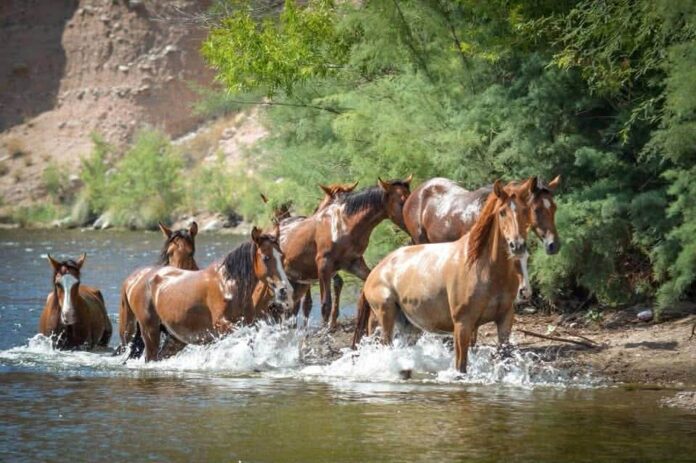
ARIZONA-A newly approved state contract will result in the removal of more than half of the Salt River wild horse herd over the next five years, a plan that is legally authorized under Arizona law but broader in scope than many members of the public may realize.
In February, the Arizona Department of Agriculture (AZDA) awarded a new herd management contract to the Salt River Wild Horse Management Group (SRWHMG), authorizing a phased reduction of the herd from its current count of 274 horses to a target population of 120 by the end of 2030. In a February 18, 2026, press release, SRWHMG announced it had been awarded what it described as a five-year contract and said it would continue its humane management of the Salt River wild horses, while acknowledging that the new management plan calls for a significant reduction in herd size.
The removals are governed by the Salt River Horse Act, codified as A.R.S. § 3-1491, enacted by the Arizona Legislature in 2016 and signed into law by former Governor Doug Ducey. The statute makes it a Class 1 misdemeanor to harass, injure, capture, euthanize, or kill a Salt River horse without written authorization from the state or a county sheriff. At the same time, the law grants AZDA authority to issue written authorization for such actions when deemed necessary for humane purposes or public safety and allows the agency to enter into agreements with private entities to carry out herd management. Under that authority, AZDA approved a detailed management plan attached to the contract, which functions as the statute’s required written authorization for removals.
While SRWHMG has characterized the plan as a reluctant compromise driven by procurement requirements, the approved management plan establishes a defined removal schedule. According to the plan, approximately 25 horses are to be removed each year from 2026 through 2029, with an additional 28 removals planned for 2030. The plan defines annual end-of-year count figures as maximums that must be reached, allowing removals to be adjusted upward if birth or death rates do not align with projections. Fertility control alone is not expected to achieve the required population reduction.
In its press release, SRWHMG stated that AZDA’s request for proposals included, for the first time, a requirement for “humane removal of horses from the herd,” and said the organization needed to include removals in its proposal or risk losing the contract.
“After many years of protection, agreeing to removals was incredibly difficult,” said Simone Netherlands, founder and president of SRWHMG. “But considering the alternative contractor, we determined the herd would be worse off without us. For their ultimate safety, we felt we needed to compromise.”
The organization further asserted that it submitted a proposal to prevent the contract from being awarded to a competing bidder whose approach, according to SRWHMG, focused on large-scale removals. The group referenced previous removals of Alpine horses from the Apache-Sitgreaves National Forest and said litigation related to those removals and the treatment of those horses is pending.
Under the new contract, SRWHMG says it intends to rely on gradual relocations to pre-vetted sanctuaries, including its own Prescott-area facility, rather than large-scale roundups, and to use fertility control to limit removals as much as possible. The organization estimates removals will average about 25 horses annually until the target population is reached.
The contract and management plan authorize removals under a range of circumstances, including population management, injury, illness, and public safety concerns. Once a horse leaves the Salt River Horse Management Area — whether due to relocation, adoption, or treatment for a natural injury — it is permanently barred from returning to the herd. Relocated horses may be placed in AZDA-approved sanctuaries or transferred to private adopters under adoption agreements that prohibit resale or slaughter.
The plan also authorizes euthanasia in emergency or severe medical cases. Both chemical euthanasia and ballistic euthanasia are permitted when deemed necessary and carried out in accordance with veterinary guidelines, with approval and documentation required. The contract does not require public reporting on the frequency or circumstances of euthanasia.
Daily monitoring of the herd is primarily carried out by trained volunteers who operate under SRWHMG’s protocols. Volunteers document injuries, movement, and herd conditions and enter data into a centralized database that tracks each horse’s identity, health history, genealogy, fertility treatments, and death. AZDA is granted access to the database and retains ownership of the records upon termination of the contract. Volunteer communications and public messaging related to herd operations are subject to approval, and volunteers are required to follow AZDA-approved guidance.
SRWHMG emphasized in its press release that it receives no state funding under the agreement, stating, “The non-profit is funded entirely by public donations, as the contract provides no compensation and no government grants.” The contract itself describes the agreement as a zero-cost service contract, meaning the State of Arizona pays nothing for herd management, and all operational costs are borne by the nonprofit.
Legal experts note that the removals are permissible under A.R.S. § 3-1491 because AZDA has issued written authorization and entered into a formal agreement with a private nonprofit, as the statute allows. The law does not define “humane purposes,” leaving the agency with broad discretion to determine which actions are necessary to protect herd health, public safety, or environmental conditions. However, the statute does not explicitly authorize removals solely to meet a numeric population target, a distinction that has drawn scrutiny because the legality of removals depends on maintaining a connection to humane necessity or safety rather than treating the population goal as an independent mandate.
The Salt River horses are not protected under the federal Wild Free-Roaming Horses and Burros Act and are instead managed under state law and agreements with the U.S. Forest Service. That framework gives Arizona far greater control than exists for federally protected herds. While SRWHMG emphasizes its long history of fertility control, rescue efforts, public education, and drought response, the scope of authority delegated under the current contract, the fixed removal schedule, and the lack of mandatory public reporting on removals and euthanasia have raised questions about transparency and public understanding.
As removals move forward, the program remains legal under Arizona law as structured, but it relies heavily on agency discretion and continued compliance with statutory limits, a balance that is likely to remain under close public and legislative scrutiny.